The Bolaven Plateau in southern Laos is one of Asia's most promising coffee regions. Rising between 1,000 and 1,350 meters above sea level, this fertile highland is home to rich volcanic soil, an optimal climate, and a coffee tradition stretching back a century. The name itself comes from the Laven people, the plateau's original inhabitants, who have farmed its red earth for generations.
At Volcana Coffee we are proud to work with local farmers who bring passion, knowledge, and dedication to every step of the coffee journey. But before any human skill enters the picture, the land itself does extraordinary work — and understanding that terroir explains why coffee from this specific place tastes the way it does.
Volcanic Soil, Exceptional Flavor
The plateau is the remnant of an ancient volcanic field: layer upon layer of basalt laid down by eruptions millions of years ago, weathered into deep, friable, iron-rich red soil. Volcanic soils like these are prized in coffee growing worldwide — Guatemala's Antigua valley, Costa Rica's Central Valley, and Panama's Boquete all share this geological gift — because they hold water well, drain excess away, and continuously release minerals as they weather.
For the coffee tree, that means steady access to potassium, magnesium, phosphorus, and micronutrients through the whole cherry-development cycle. Potassium in particular is closely linked to sugar accumulation in the fruit, and sugars in the cherry become sweetness and body in the cup. When cuppers describe Bolaven Arabica as having a balanced body, pleasant acidity, and sweet chocolatey notes, they are tasting basalt chemistry expressed through fruit.
Depth matters as much as chemistry. Bolaven soils run meters deep before hitting rock, so coffee roots explore freely, buffering the trees through dry spells that would stress plantings on thin soils. Healthy, unstressed trees fill their seeds slowly and completely — the foundation of dense, evenly roasting green coffee.
An Ideal Climate for Slow Maturation
Altitude does for temperature what basalt does for nutrition. At 1,000–1,350 meters, the plateau sits high enough that average temperatures hold between 18 and 22°C year-round, with cool nights that regularly drop below 15°C in the harvest months. Cherry ripening slows dramatically in cool conditions, and slow ripening is one of specialty coffee's most reliable quality levers: the longer a cherry hangs, the more sugars and acid complexity it accumulates.
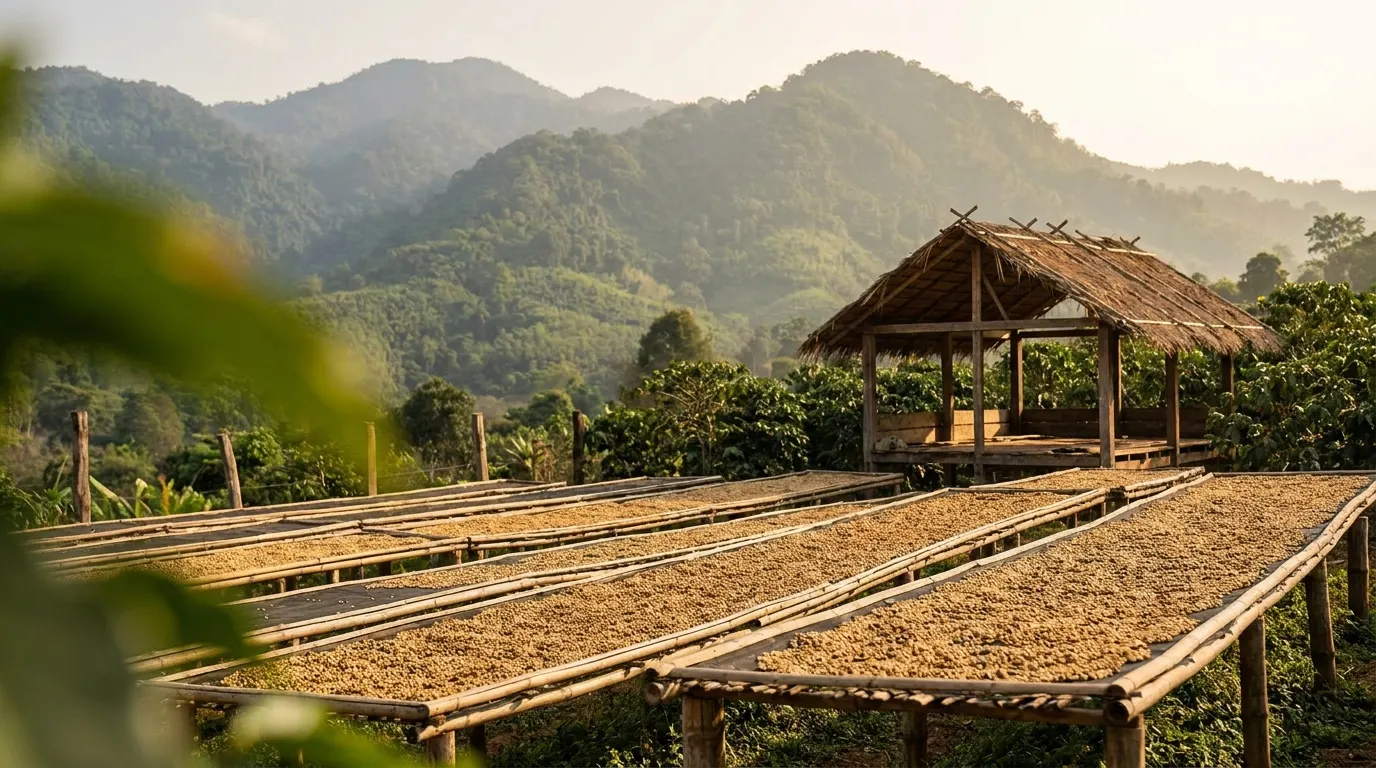
Rainfall is equally well arranged. The southwest monsoon delivers 1,800–2,500 mm of rain between May and October — ample water during flowering and fruit development — followed by a reliably dry window from November through February that coincides exactly with harvest. Dry harvest weather is a processing superpower: cherries can be picked ripe and dried on raised beds without the constant rain-interruption risk that plagues many origins.
The plateau's geography adds a final refinement. As a broad elevated table rather than steep mountainsides, it offers vast tracts of gently rolling farmland at consistent altitude — easier to farm, easier to pick, and remarkably uniform in microclimate, which shows up as consistency across lots.
A Sustainable Future
Great coffee starts with healthy land and secure farmers. Most Bolaven farms are smallholdings of one to three hectares that have grown coffee for decades — established agricultural land, not cleared forest — which is why the plateau is well positioned for the EU Deforestation Regulation era of traceable, deforestation-free sourcing.
Volcana Coffee's model keeps the chain short: we buy ripe cherry directly from farming families at premiums over local market price, process centrally with water-efficient equipment, return composted pulp to the fields, and invest in picking and drying training that raises both quality and farmer income. Long-term partnerships, fair prices, and sustainable practices are how a hidden origin becomes a lasting one.
The terroir was always here. What is changing is the world's awareness of it — and every carefully processed lot that leaves Pakse makes the case that the Bolaven Plateau belongs in the same conversation as coffee's famous volcanic origins.
“Our goal is simple: to produce high-quality coffee while caring for our people and our land. That's what makes Bolaven Plateau so special.”— Local farmer, Paksong District