Coffee is a forest understory plant. Coffea arabica evolved beneath the canopy of Ethiopian highland forests, and for most of coffee's cultivated history it grew the same way — under trees. The 20th century's push for yield cleared much of that shade for dense 'sun coffee' monocultures. The 21st century is rediscovering, with data, what the canopy was doing all along.
What Shade Does for Quality
Shade moderates the microclimate: cooler days, warmer nights, less water stress. Cherries under partial shade ripen more slowly and more evenly than sun-exposed fruit — and slow, even ripening is one of the most consistent predictors of cup quality, associated with higher sugar accumulation and denser beans. Studies across origins repeatedly link moderate shade (30–50% cover) with improved sensory scores versus full sun at the same altitude.
Shade also buys altitude, climatically speaking: a shaded farm at 1,100 m can approximate the temperature profile of an open farm hundreds of meters higher. For origins near the quality-altitude boundary, that arithmetic matters enormously.
What Shade Does for the Farm
The canopy is a working part of the farm system. Leaf litter builds organic matter and moisture retention in the soil; nitrogen-fixing shade species like Erythrina and Inga fertilize from above; deep tree roots cycle nutrients coffee roots can't reach; and the structural diversity houses birds and insects that suppress pests — coffee berry borer predation among the documented effects. Shade farms weather droughts and heat waves that damage exposed plantings, an increasingly non-theoretical advantage.
The tradeoff is yield per hectare in good years — sun monocultures produce more, faster, at the cost of higher input needs and fragility. For smallholders, shade systems' lower costs and added products (fruit, timber, firewood from the canopy itself) often make them the better livelihood even before premiums.
Shade on the Bolaven Plateau
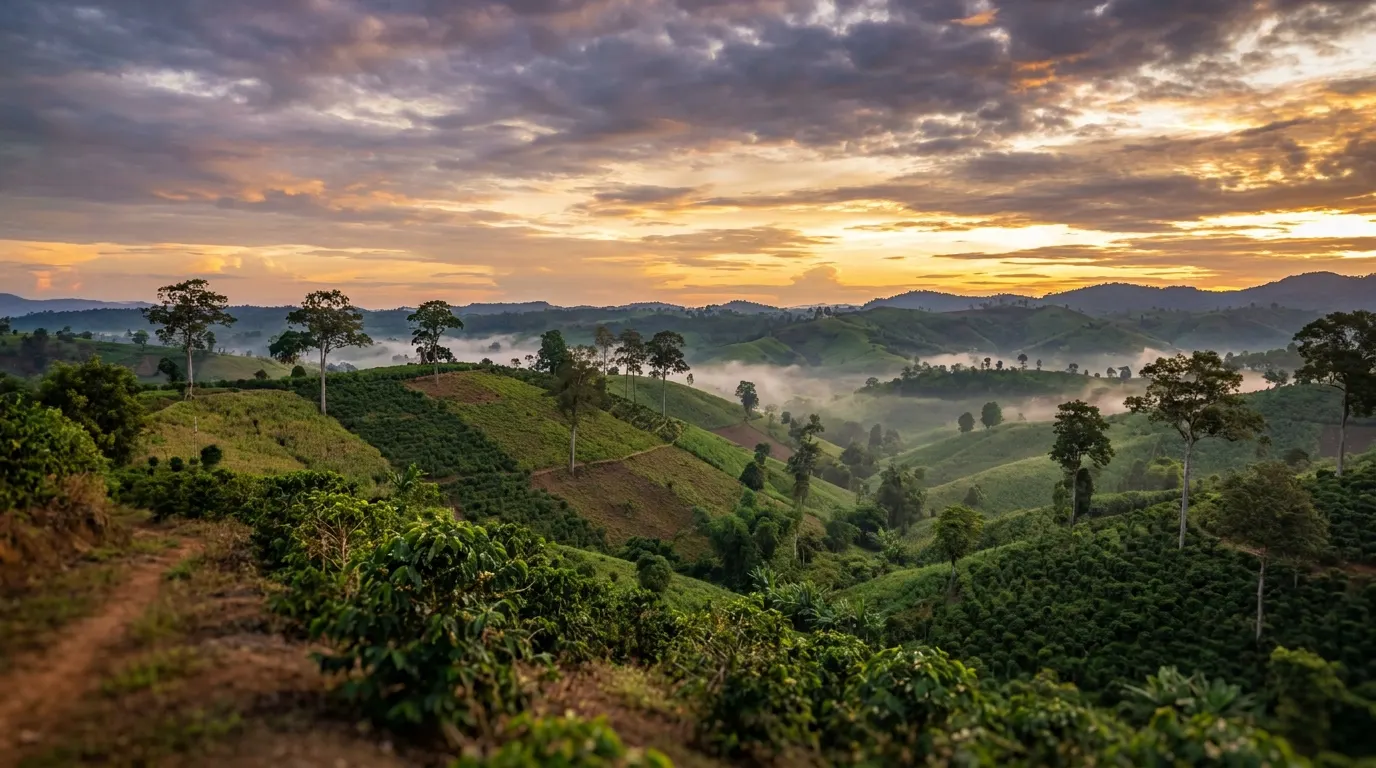
Lao smallholder coffee was never industrialized into sun monoculture — plots grew under retained native trees and planted shade as a matter of tradition and necessity. Walk a Paksong farm and you move through layers: tall natives, fruit trees, then coffee. It is agroforestry that predates the word.
This heritage is now a market asset: shade-grown character in the cup, biodiversity and carbon arguments for sustainability-minded buyers, and resilience for the farmers themselves. In an era when the EU's deforestation regulation makes forest-friendly production a trade requirement, origins that never cut their canopy start the race ahead. The old way, it turns out, was the durable way.