Coffee is not native to Laos, but it found one of its best homes there. The century-long story of how an African plant crossed the world to a remote volcanic plateau — and survived colonialism, war, and collectivization to become the country's most valuable agricultural export — explains a great deal about what makes Lao coffee distinctive today.
The French Discovery (1915–1940)
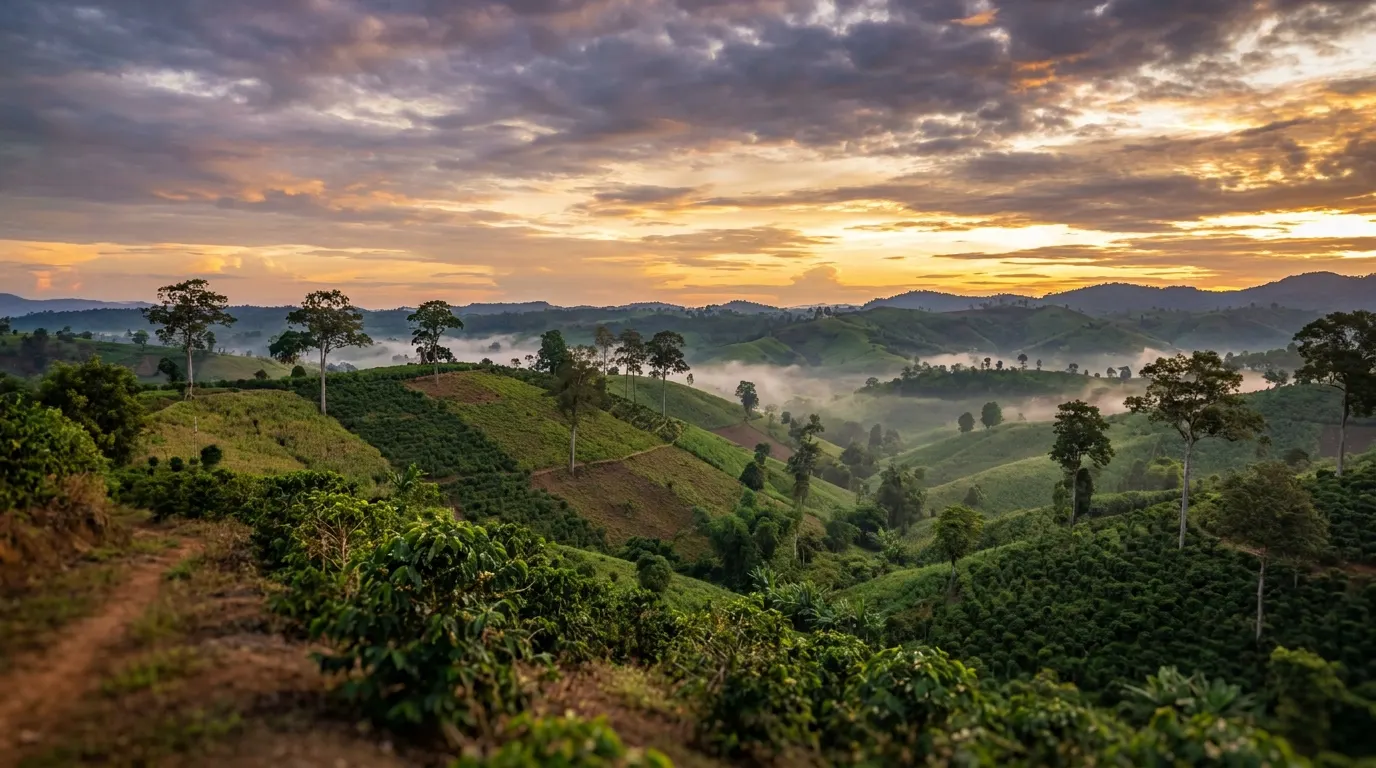
French colonists began experimenting with coffee across Indochina in the late 19th century, but their attempts in lowland Laos failed — too hot, wrong soil. Around 1915–1920, planters trialed the Bolaven Plateau in the country's south and found something remarkable: volcanic soil and highland climate that resembled successful coffee country half a world away. By the 1930s, French plantations on the plateau were exporting Arabica praised in Marseille and Paris.
The colonists planted Typica and Bourbon stock alongside Robusta, establishing the species mix that persists today. They also, less happily, established the extractive plantation model — Lao and Laven labor, French profit — that independence would later unwind.
War, Collectivization, and Survival (1950s–1980s)
The mid-century decades were brutal for the plateau. The region sat near the Ho Chi Minh Trail during the Second Indochina War, and Laos became, per capita, the most heavily bombed country in history. Coffee farms were abandoned, and unexploded ordnance still constrains land use in parts of the southeast of the plateau today — one reason existing farmland, farmed for generations, dominates Lao coffee.
After 1975, plantations were collectivized and production directed toward state trading partners, with volume prioritized over quality. Arabica declined — it demands care that command economics rarely delivered — and hardy Robusta became the default crop. Yet smallholder families kept their trees, and coffee knowledge survived in villages even as the industry around it thinned.
Liberalization and the Smallholder Boom (1990s–2010s)
Market reforms from the late 1980s returned coffee to family hands, and the crop became rural southern Laos's cash engine. Production climbed through the 1990s and 2000s as regional traders bought dried cherry at the farm gate — an efficient but anonymous system that fed Lao beans into the world market with no origin identity and gave farmers no incentive beyond weight.
The turning point came in the 2000s and 2010s: development programs and pioneering cooperatives introduced washing stations, cupping labs, and quality-linked pricing. For the first time, a Bolaven farmer could earn more by picking riper. Arabica replanting accelerated — high-yielding rust-resistant Catimor foremost — and Lao coffee began appearing under its own name on specialty menus abroad.
The Specialty Era (Today)
Today Laos produces roughly half a million bags annually, with exporters like Volcana Coffee running the full modern playbook: selective harvest, controlled fermentation, SGS-inspected lots, EUDR-ready traceability, and direct relationships with roasters from Europe to East Asia. Washed Fine Robusta — a category that barely existed a decade ago — has become one of the origin's calling cards.
A century after French planters guessed right about a volcanic plateau, the third act of Lao coffee belongs to the people who always grew it. The infrastructure is finally catching up to the terroir — and the world is beginning to taste the difference.