The EU Deforestation Regulation (EUDR) is the biggest compliance change in the coffee trade in a generation. Coffee is one of the seven commodities covered, and any company placing coffee on the EU market must prove — with data, not promises — that it was grown on land not deforested after 31 December 2020. Here is what that means in practice for importers, and what you should demand from your origin partners.
What the Regulation Actually Requires
Three pillars. First, geolocation: every plot of land that produced the coffee must be identified — point coordinates for plots under four hectares, polygon boundaries above that. Second, a due-diligence statement (DDS) filed in the EU's information system before the goods clear customs, referencing that geolocation data and a risk assessment. Third, traceability documentation connecting the physical lot to those specific plots.
Obligations fall on the EU 'operator' — the importer of record — but the data can only come from origin. That makes your exporter's data capability a purchasing criterion as real as cup quality: an excellent coffee without plot coordinates is, for EU purposes, unshippable.
What a Good Exporter Provides
A prepared exporter delivers a per-lot EUDR package: GPS coordinates or polygons for every contributing farm plot, harvest-year linkage between plots and the lot, supplier declarations, and supporting evidence of land-use history (satellite imagery baselines are typically referenced against 2020). The package should arrive with the shipping documents — not weeks after arrival while your coffee sits blocked.
Ask three questions before contracting: How many farms feed this lot, and are all geolocated? What format do you deliver coordinates in (GeoJSON is the emerging standard)? Can you demonstrate the plots against a 2020 forest baseline? Hesitation on any of these is a red flag.
Why Laos Is Well Positioned
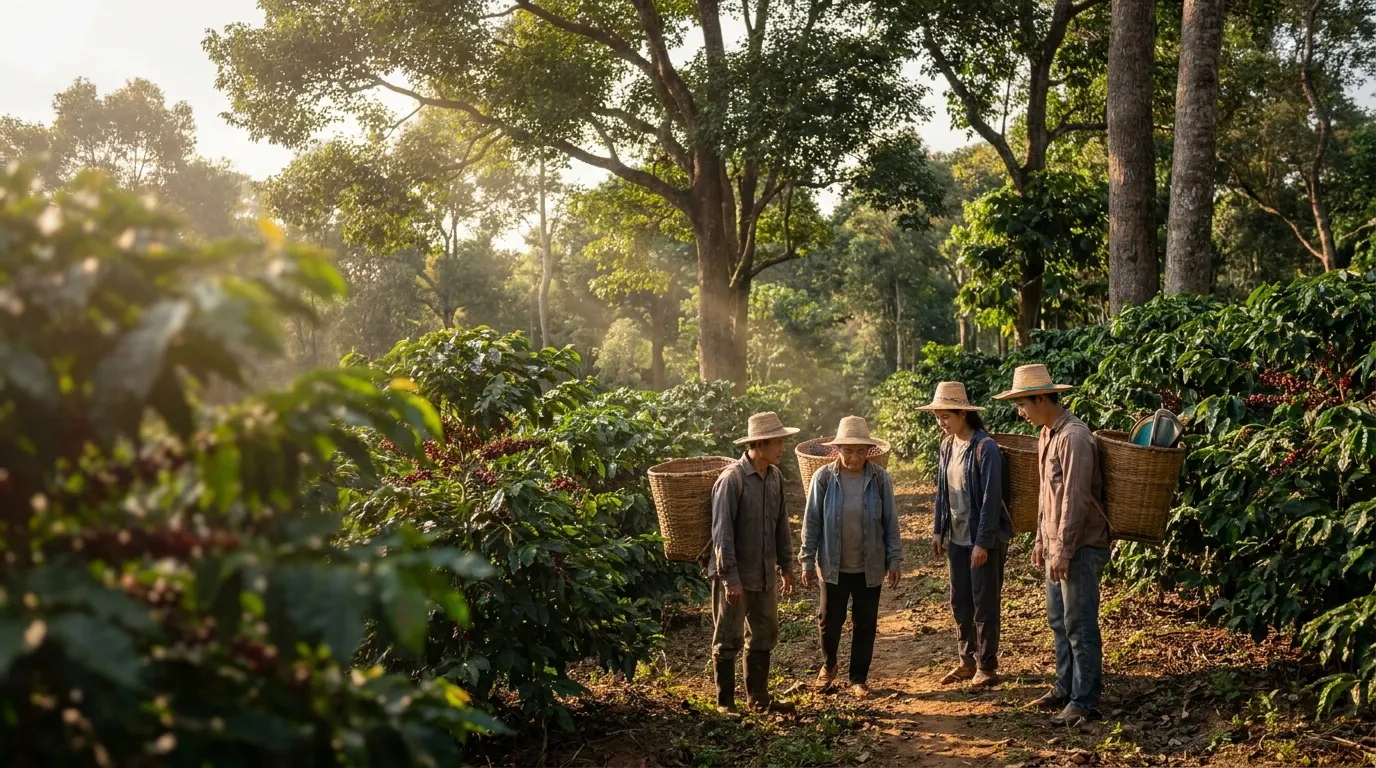
EUDR risk concentrates where coffee expands into forest frontiers. The Bolaven Plateau is the opposite case: a smallholder landscape farmed for up to a century, where today's coffee plots were coffee plots long before the 2020 cutoff. Demonstrating deforestation-free origin is a documentation exercise, not a remediation project.
Volcana Coffee collects plot-level GPS data across our farmer network as standard, links plots to lots at the washing station, and delivers coordinate packages with every EU-bound shipment. For importers, that means Lao coffee is not just compliant — it is low-risk in the classification sense, simplifying your own due-diligence workload.
Practical Steps for Importers
Map your supply chains now rather than at customs: inventory which origins and suppliers can already deliver geolocation, and test-file DDS entries with your first compliant lots to debug the workflow. Build EUDR data delivery into contracts explicitly — specify format, timing, and remedies. And treat compliance capability as a relationship signal: exporters who invested early in traceability tend to be the ones who invested early in quality, too.
The regulation rewards exactly the kind of short, documented, smallholder-direct supply chains that quality-focused buyers already prefer. If your sourcing is good, EUDR is paperwork. If it is opaque, it is an overdue reckoning — and a reason to talk to origins that did the work.