Ask processing experts where most coffee defects are born and the answer is rarely fermentation — it is drying. Between wet parchment at 50%+ moisture and export-stable green coffee at 10–12% lies a window of one to four weeks in which mold, ferment, phenolic taints, and uneven fading all lurk. The method a producer chooses for that window shapes both quality and cost.
Raised Beds: The Specialty Standard
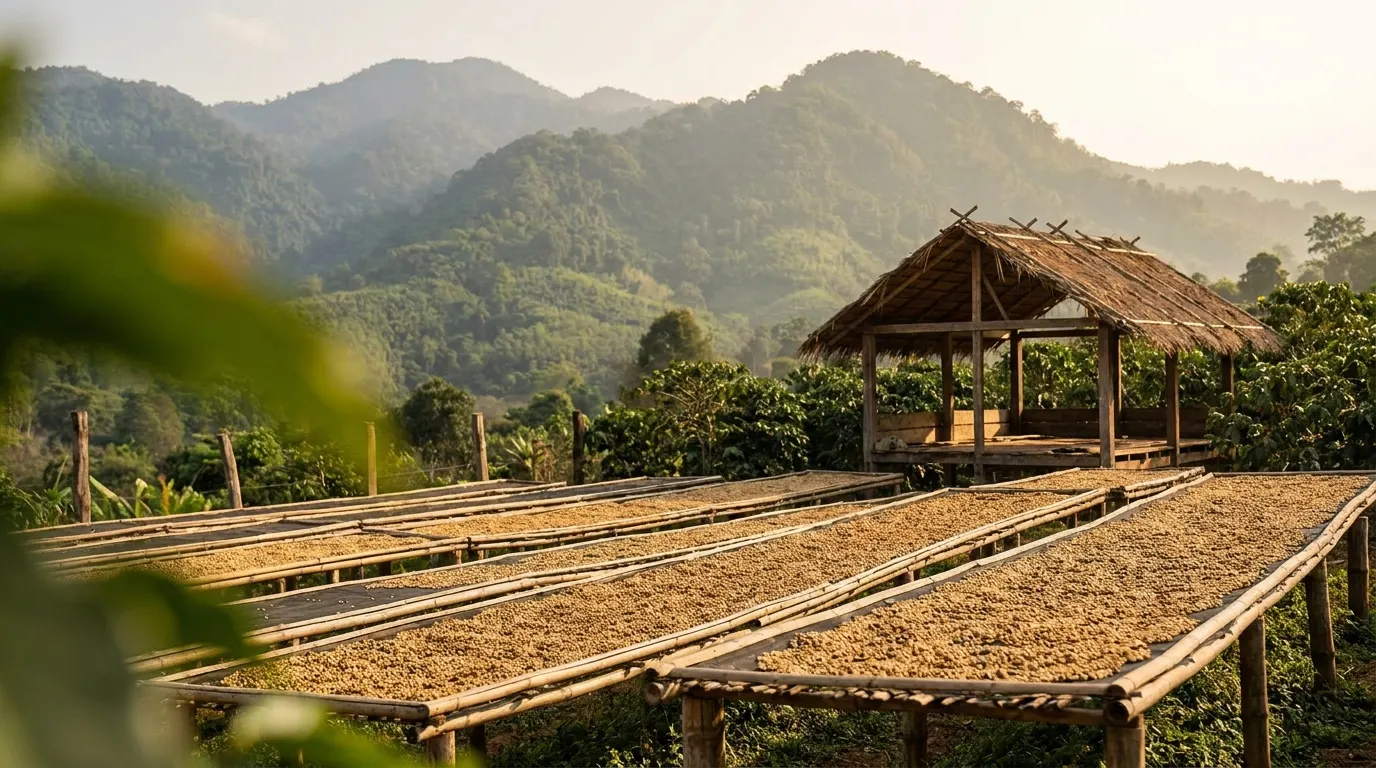
African-style raised beds — mesh tables at waist height — dry coffee on all sides with air circulating underneath, which is their decisive advantage: no contact with ground moisture, faster and more even early drying, and easy turning by hand. Thin layers and frequent turning produce the most uniform moisture and water activity profiles of any sun method, and beds double as a final sorting station where pickers remove defects as they turn.
The costs are land and labor: beds hold less coffee per square meter than a heaped patio, and the turning discipline is constant. On the Bolaven Plateau, where dry-season sun is reliable and harvest labor is village-based, beds are the natural choice — all Volcana lots dry this way, over roughly 6–12 days for washed parchment and up to four weeks for naturals.
Patios: Scale With Discipline
Concrete or tiled patios — the classic image of Brazilian and Central American mills — dry large volumes economically: coffee raked into rows, turned by hand or small machines, covered at night. Done well, patio drying is excellent. Its risks are ground heat spikes in thin layers, moisture wicking in thick ones, and rain response time across a large exposed surface.
The difference between a great patio operation and a poor one is pure management: layer depth, turning frequency, night covering, and drainage. Buyers visiting origin learn more from ten minutes watching a drying area than from an hour in a meeting room.
Mechanical Dryers: Insurance and Control
Rotary and vertical dryers finish coffee with heated air over 24–72 hours, immune to weather. In humid origins — Colombia's wetter zones, Sumatra — they are essential infrastructure; elsewhere they serve as rain insurance and a finishing tool that takes sun-started coffee down the last few points gently. The quality risk is temperature: bean temperature above roughly 40°C damages embryo and cup, so good operators run low and slow, often combining sun and machine.
No method is inherently superior; each is a fit between climate, volume, and quality target. What is universal is the endpoint: 10–12% moisture, water activity below 0.70, verified before bagging. However the water leaves the bean, those numbers — not the romance of the method — are what protect the cup on its way to you.